
Or, well, actually the embroidery, if you want to be technical.
A little background: roughly a thousand years ago, a duke named William was named as the next king of England. He was a Norman, meaning he was from the northern part of France. Another nobleman, Harold, this time an actual Anglo-Saxon from England, took the crown out from under William even though he promised he wouldn’t. You can’t just let something like that slide, so William called up his brother and a bunch of his friends to sail up to England, defeat Harold, and take back the crown.
William succeeds in doing this, pretty handily actually. The consequences of William becoming King of England are so far-reaching throughout history that we can’t even fully explicate them. This event in history accounts for fully one fourth of the English language; the ethnic and religious makeup of England and France, and therefore a dozen other nations; governmental and societal frameworks throughout Europe; and the status of England as a global power (although this is on the wane).
Why am I talking about this? One, because history classes in America don’t put a whole lot of emphasis on it, and two, because I got to see a piece of art called the Bayeux Tapestry.
The tapestry, roughly 70 meters in length, depicts the story of how little Will became William the Conqueror, King of England in a series of explanatory pictures. It was hand-stitched by sunlight and candlelight by extremely skilled artisans in the early 1000s. Displayed annually in the Bayeux Cathedral, it was meant to teach the illiterate populace their own history. It was and is an absolute marvel of technical skill. It was completely lost to history for six hundred years.
The thing is so, so old.
I was given a little radio at the door, which explained the narrative of the tapestry as I walked. At two points, I had to hit the pause button and lean against the back wall for a breather. Not because I was tired, but because I saw something that truly took my breath away. The first was this:
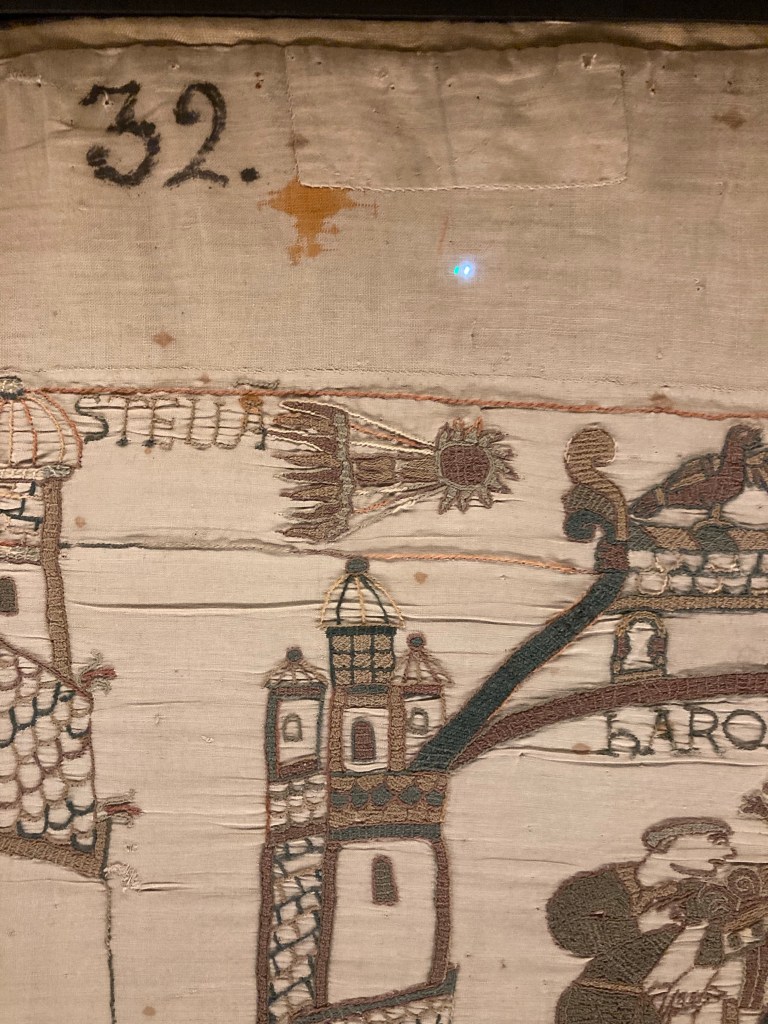
That’s Halley’s Comet. It appeared in the year leading up to William’s Conquest, and was seen as an omen. Logically, I know that a periodically-appearing comet would have been visible back then, but in the moment I was overcome. A thousand years ago, all of these people saw something extraordinary in the sky, and they did their best to depict in a way others could understand. And I saw, and I understood.
The second was this:
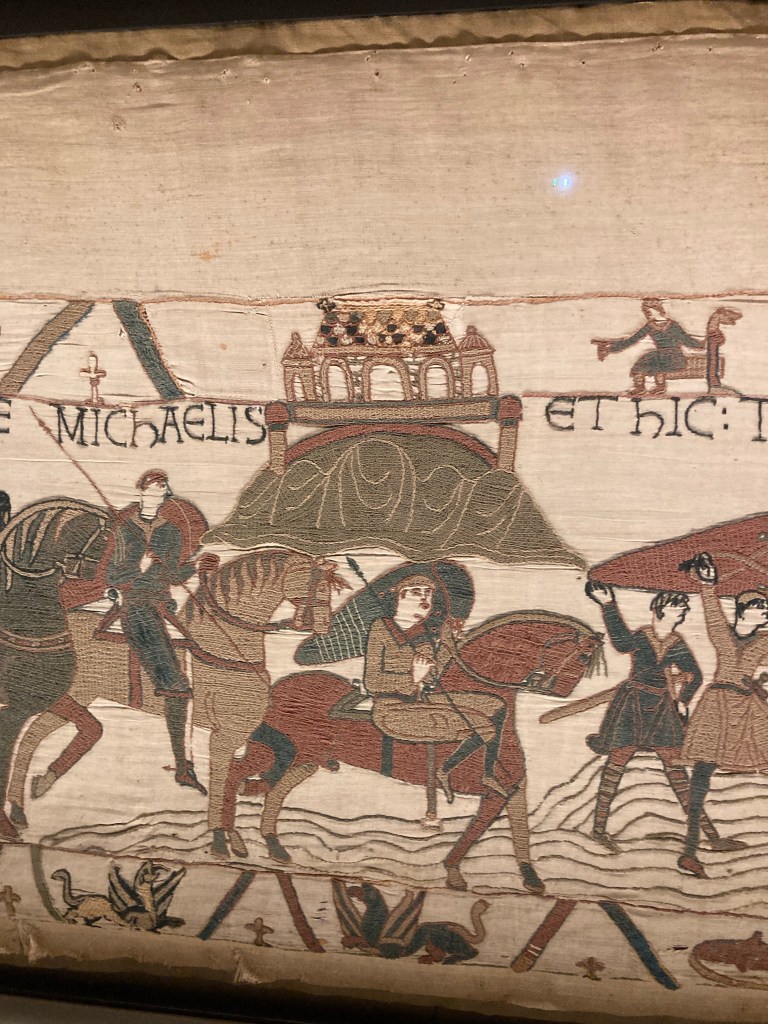
Mont St Michel. Seven years ago, I went on a school trip to France that really did alter the course of my life. It was the first time I ever saw the broader world. But the exact moment that changed things for me happened here, at this place depicted in the tapestry. Mont St. Michel is a huge church complex build completely into a teeny little island. On the school trip, we took a day to explore it. I had never in my life seen something so old, and certainly never something so old and alive. The place was rich in a depth of history I had never considered. I so clearly recall standing on a ledge overlooking the ocean and the land, and promising to empower myself to return someday.
That place, which is so precious to me, so personally important to me… here it was, embroidered so painstakingly. Again, I know in my head how old Mont St Michel is. But, again, my god, look at how this thing has mattered to people. To me, to them, to us today. We can make things that outlast ourselves.
Those people below the hill in the embroidery, they’re preparing to sail to war. When they looked across the water at Mont St Michel, what were they thinking about? Were they in awe, too? Praying to make it back to see it again?
I’m keeping that promise I made seven years ago. I’m a French speaker now. I live in France, work in France, eat and sleep here, too. What would 16-year-old Allison think? That girl from the past, right alongside the warriors from the tapestry. What would she think?
Much to consider.
Cordialement,
Allison
 Flan in France